「RoboCar AGV 200T」: A Solution for Ultra-Heavy Material Transportation
Eliminating Falling-Load Risks and Strengthening BCP with a 200-Ton Ultra-Heavy AGV
ROBO-HI Corporation has officially begun accepting orders and providing its ultra-heavy AGV series, including the large unmanned transport vehicle「RoboCar AGV 200T」, which supports a maximum payload of 200 tons.
At heavy-industry manufacturing sites that have traditionally relied on overhead cranes and suspended transportation equipment, ROBO-HI is promoting a shift toward ground-level AGV transportation. This approach aims to eliminate the risks of falling loads and equipment collapse within factories while strengthening BCP (Business Continuity Planning) in the event of a major earthquake.
Background and Social Challenges / Life-Safety Risks and Vulnerability to Major Earthquakes in Overhead Crane Transportation
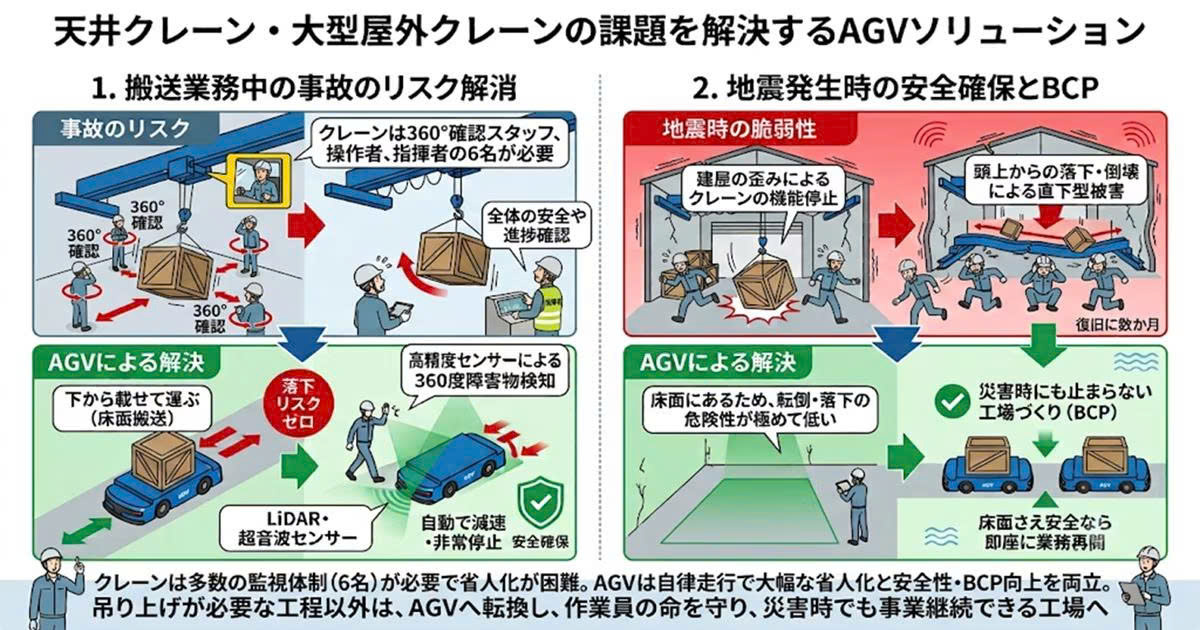
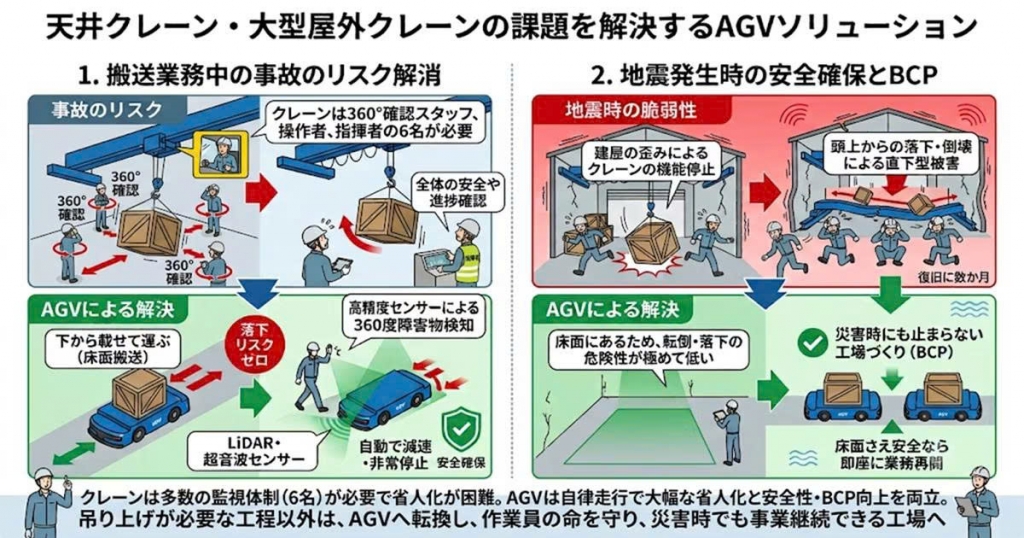
At sites such as heavy industries, shipyards, plant construction facilities, and large machinery manufacturing plants, overhead cranes and suspended transportation equipment have long played a central role in transporting ultra-heavy objects weighing from several tens to several hundreds of tons. However, because these systems structurally rely on “suspending loads overhead,” it is difficult to completely eliminate the risk of falling-load accidents caused by damage to lifting equipment as well as accidents in which workers are trapped or crushed by falling objects.
An even more serious challenge is their vulnerability during major earthquakes. In past major earthquakes, there have been cases in which intense seismic motion caused overhead cranes to jump from their rails, derail, and fall. In other cases, deformation of the running rails caused by tilted support columns or buildings resulted in crane equipment collapsing or becoming immobilized, leading to significant damage.
The danger of an overhead crane falling not only directly threatens the lives of workers but can also destroy buildings and equipment, requiring several months for recovery. This represents a serious threat to BCP (Business Continuity Planning) in the manufacturing industry.
Solution to the Social Challenge / Achieving Zero Falling-Load Accidents and Immediate BCP Recovery by Shifting to Ground-Level AGVs
ROBO-HI proposes a solution that shifts the primary transportation method in heavy-industry facilities from “overhead suspension” to “ground-level autonomous cart-type AGVs.”
By eliminating cranes themselves and shifting to a method of “loading and transporting materials from underneath on the factory floor,” the safety structure and disaster resilience of the workplace can be fundamentally improved.
1. Toward “Zero” Falling-Load Accidents During Transportation
Because the system transports materials on the factory floor without requiring a suspended structure, risks such as “loads falling from overhead” and “crane columns or crane bodies overturning or collapsing” are eliminated from the transportation process.
In addition, a 360-degree obstacle detection system using high-precision LiDAR sensors can detect people and obstacles and automatically slow down or perform an emergency stop, helping prevent collisions and entrapment accidents before they occur.
2. Eliminating Overhead Hazards During Earthquakes and Enabling Immediate Business Continuity
Even during an earthquake, there are no falling objects directly above workers, contributing to significantly improved evacuation procedures and worker safety.
Furthermore, unlike overhead cranes, AGVs are not affected by deformation of buildings or columns or by derailment from rails. Therefore, even after a disaster, transportation operations can be resumed immediately once the safety of the factory floor has been confirmed.
This contributes to building “resilient factories” that can keep manufacturing lines running even in emergencies.
Comparison Between Overhead Cranes and Ultra-Heavy AGVs
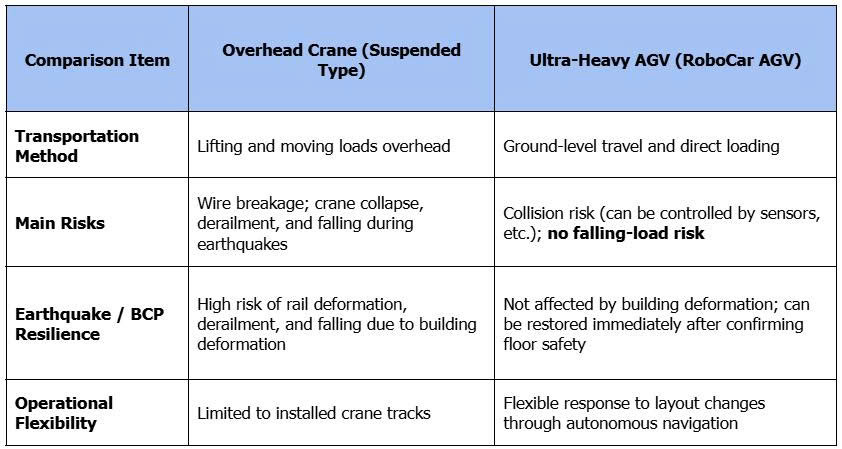
Note: As AGVs are transportation equipment, the risk of contact during operation cannot be considered completely zero. However, ROBO-HI is working to ensure safety at sites by using safety systems such as long-range LiDAR, multi-layer obstacle detection sensors, and smooth-stop control, taking an approach to site safety that differs from suspended transportation systems.
Key Features of the「RoboCar AGV 200T」Ultra-Heavy Material Transport Vehicle
As a concrete solution to fundamentally address these challenges, ROBO-HI proposes the ultra-heavy AGV「RoboCar AGV 200T」. By replacing transportation between production processes—except for limited processes where lifting is required—with this product, ROBO-HI aims to improve workplace safety.
1. Outstanding Transportation Capacity with a Maximum Payload of 200 Tons
With a robust frame structure and a multi-axle distributed drive system,「RoboCar AGV 200T」can transport ultra-heavy loads safely and stably.
2. High-Precision Driving Control and Safety Functions
In addition to proprietary synchronized driving control technology developed by ROBO-HI, the vehicle is equipped with obstacle avoidance and safety-stop mechanisms using multiple layers of sensors, including LiDAR.
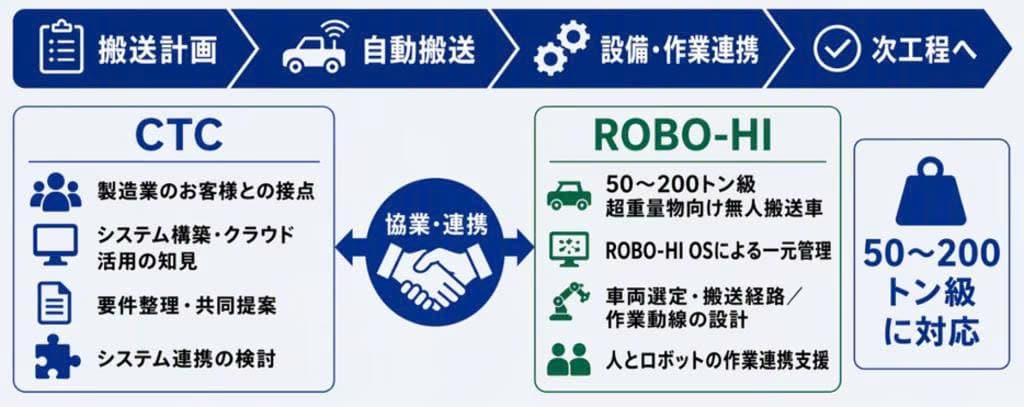
3. Centralized Management with「ROBO-HI® AOS」
By integrating with the operation management OS, multiple AGVs can be operated synchronously and remotely monitored through a centralized system. This supports the development of a safe and unmanned smart factory.
Guidance on Heavy Material Transportation Optimization and Implementation Assessment
ROBO-HI regularly conducts on-site surveys and suitability assessments by hearing about customers’ current transportation routes, load conditions, and building environments at their factories and facilities.
ROBO-HI assesses “whether transportation can be replaced with AGVs” and “what safety and productivity improvements can be expected.”