「ROBO-HI START」: Deploy Robots Without Infrastructure Renovation
ROBO-HI Corporation has launched ROBO-HI® START, a new service that enables robot deployment in existing office buildings and commercial facilities without requiring elevator integration or security door modification.
The service addresses two of the biggest barriers to robot adoption in existing facilities: high infrastructure renovation costs and operational challenges faced by frontline staff. Through an optimized human-robot collaboration model,「ROBO-HI START」delivers a practical labor-saving solution that improves operational efficiency while accelerating digital transformation.
Background
Although cleaning robots are increasingly expected to help address labor shortages, deploying them in existing buildings remains a major challenge.
1. High Infrastructure Upgrade Costs
Conventional robot deployment often requires elevator integration to enable movement between floors, resulting in significant costs and lengthy implementation periods. For many facility managers, the high initial investment makes adoption difficult.
2. Operational Challenges
Whenever a robot is moved to another floor, staff traditionally need to manually switch floor maps. Incorrect operations may accidentally delete map data, creating frequent operational issues.
Key Features of「ROBO-HI START」
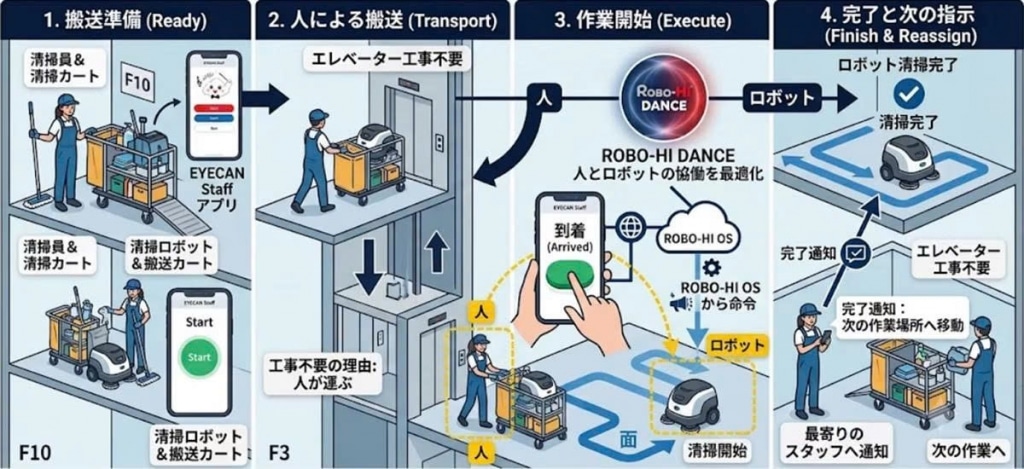
1. No Elevator Renovation Required – Optimized Human-Robot Collaboration
Instead of pursuing full automation,「ROBO-HI START」adopts a practical collaborative approach.
- Staff transport robots between floors following guidance from EYECAN Staff.
- ROBO-HI DANCE coordinates tasks between humans and robots.
- Robots clean large floor areas and corridors, while staff focus on edges, corners, and other areas that robots cannot efficiently access.
Without requiring costly elevator or security door integration, organizations can begin robot operations quickly with minimal upfront investment.
2. Automatic Cloud-Based Map Switching
After moving a robot to the destination floor, staff simply tap the “Move Completed” button within the EYECAN Staff application.
「ROBO-HI OS」automatically recognizes the robot’s location and switches to the appropriate floor map without any manual configuration.
This eliminates complex setup procedures, prevents operational errors, and enables smooth day-to-day robot management.
Benefits
「ROBO-HI START」allows existing buildings that previously postponed robot adoption due to infrastructure costs or operational concerns to begin digital transformation through a practical, low-cost approach.
ROBO-HI aims to support DX across existing facilities, address labor shortages, and build a sustainable working environment where humans and robots collaborate efficiently.
Core Technologies
- ROBO-HI OS – An Autonomous Operating System that centrally manages robots, people (via EYECAN Staff), facilities, and IoT devices through cloud-based remote control.
- ROBO-HI DANCE – A field service engine that optimizes task allocation and minimizes idle time between people and robots.
- EYECAN Staff – A smartphone application that connects frontline staff with ROBO-HI OS, featuring work guidance, multilingual support, tutorials, and gamification.
Press Release
Latest Post
『RakuRo』Brought an Autonomous Mobility Experience to the “Working Vehicles Wonderland” Exhibition
2026-07-22 07:09:23