Eliminate falling load risks and strengthen BCP with the 200-ton ultra-heavy load AGV
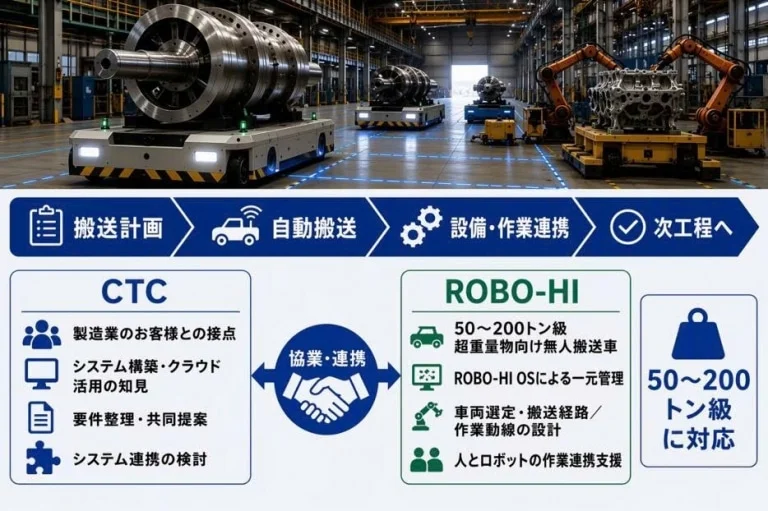
ROBO-HI Corporation has officially started accepting orders for and supplying its ultra-heavy load AGV series, including the "RoboCar AGV 200T" – a large unmanned transport vehicle capable of carrying a maximum payload of 200 tons.
In heavy industry plants that traditionally rely on overhead cranes and suspended transport equipment, ROBO-HI promotes shifting to ground-based AGV transport. This helps eliminate the risk of accidents caused by falling loads or equipment collapsing within the plant, while also strengthening BCP (Business Continuity Planning) in the event of a large-scale earthquake.
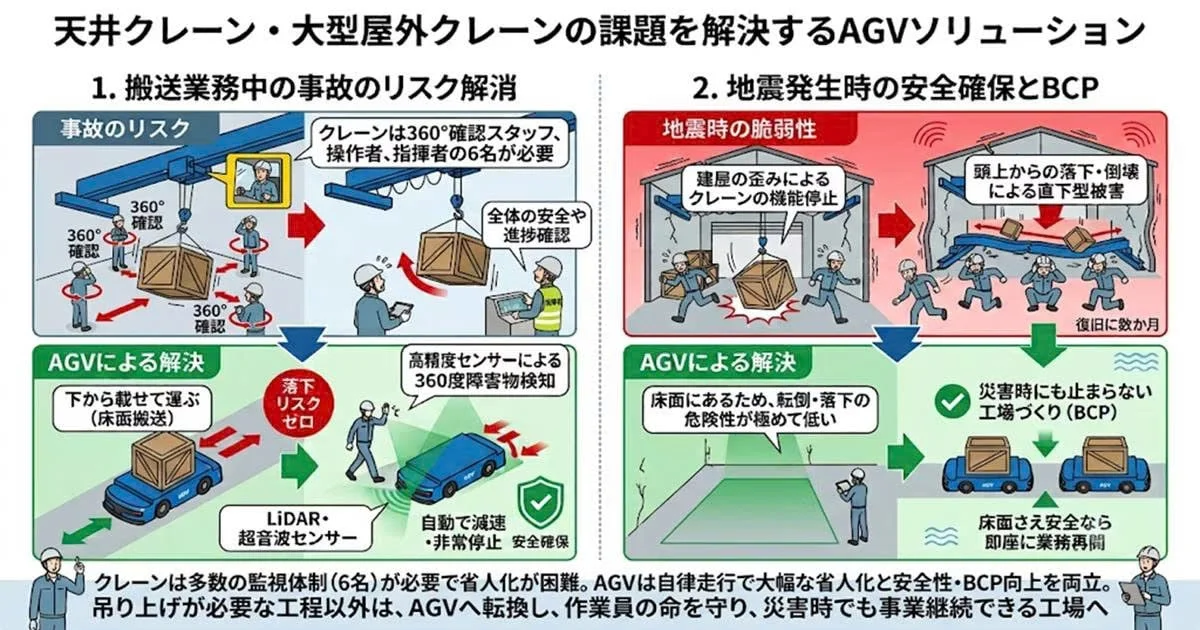
Background and Social Issues / Life risks and earthquake vulnerability of overhead crane transport
At heavy industry, shipbuilding, plant construction, and large-scale machinery manufacturing facilities, overhead cranes and suspended transport equipment have played a leading role in moving ultra-heavy objects weighing from tens to hundreds of tons for many years. However, due to the structural characteristic of "suspending cargo from above", it is extremely difficult to completely eliminate the risk of accidents caused by falling cargo due to lifting equipment failure, as well as accidents where workers are trapped or crushed between falling cargo and other objects.
An even more serious issue is the vulnerability in the event of a large-scale earthquake. During major earthquakes in the past, there have been instances where cranes were shaken so violently that they derailed and fell; or tracks were deformed due to tilted pillars or buildings, causing crane equipment to collapse or become stuck, resulting in severe damage.
A crane falling from above not only directly threatens workers' lives but can also destroy factory buildings and equipment, causing the production recovery process to take months. This is a severe threat to the manufacturing industry's BCP (Business Continuity Planning).
Solutions to Social Issues / No more falling load accidents and immediate BCP recovery by shifting to "Ground-based AGVs"
ROBO-HI proposes shifting the primary transport method at heavy industry facilities from "suspended in the air" to "ground-based autonomous guided vehicles (AGVs)".
By eliminating the crane itself and switching to a method of "placing cargo from below and transporting on the ground", the safety structure and disaster resilience of the workplace can be fundamentally improved.
1. Towards "Zero Accidents" from falling cargo during transport
Because there is no need to use suspended structures, and cargo is transported on the floor, risks such as "cargo falling from above" or "pillars and crane bodies collapsing" are eliminated from the transport process.
In addition, the 360° obstacle detection system using high-precision LiDAR sensors can detect people and obstacles, then automatically decelerate or make an emergency stop, helping to prevent collision and entrapment accidents.
2. Eliminate overhead hazards during earthquakes and maintain business operations immediately
Even when an earthquake occurs, there are no objects directly falling from above, which significantly improves evacuation capabilities and worker safety.
Furthermore, unlike overhead cranes, AGVs are not affected by building or pillar deformation, or track derailments. Therefore, even after a natural disaster, if the floor is confirmed to be safe, transport operations can be restored immediately. This contributes to building "resilient factories" that can maintain production lines even in emergency situations.
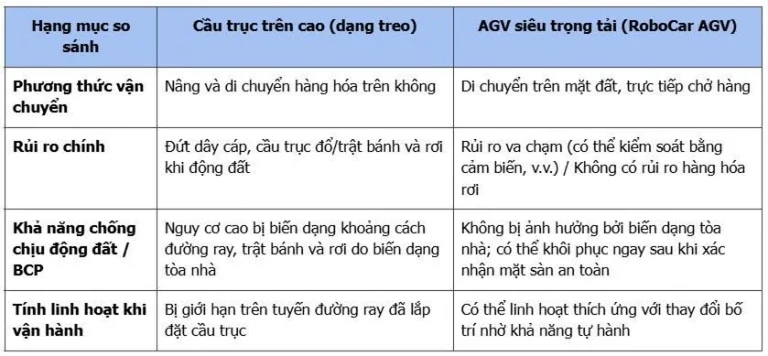
Note: Since AGVs are also transport equipment, the risk of collision during movement cannot be said to be absolutely zero. However, ROBO-HI strives to ensure on-site safety by utilizing safety systems such as long-range LiDAR, multi-layered obstacle detection sensors, and soft stop control, in a manner fundamentally different from suspended transport systems.
Key Features of the "RoboCar AGV 200T" Ultra-Heavy Load Transport Vehicle
To fundamentally solve the above issues, ROBO-HI proposes the "RoboCar AGV 200T" ultra-heavy load AGV. By replacing inter-process transport operations with this product, excluding specific processes that mandatorily require lifting equipment, ROBO-HI aims to elevate the level of workplace safety.
1. Outstanding transport capacity with a maximum payload of 200 tons
With a robust frame structure and a multi-axle distributed drive system, the "RoboCar AGV 200T" is capable of transporting ultra-heavy objects safely and stably.
2. Multi-layered safety and collision avoidance system
Alongside the synchronous motion control technology independently developed by ROBO-HI, the product is equipped with an obstacle avoidance and safe stopping mechanism through multiple layers of sensors, such as LiDAR.
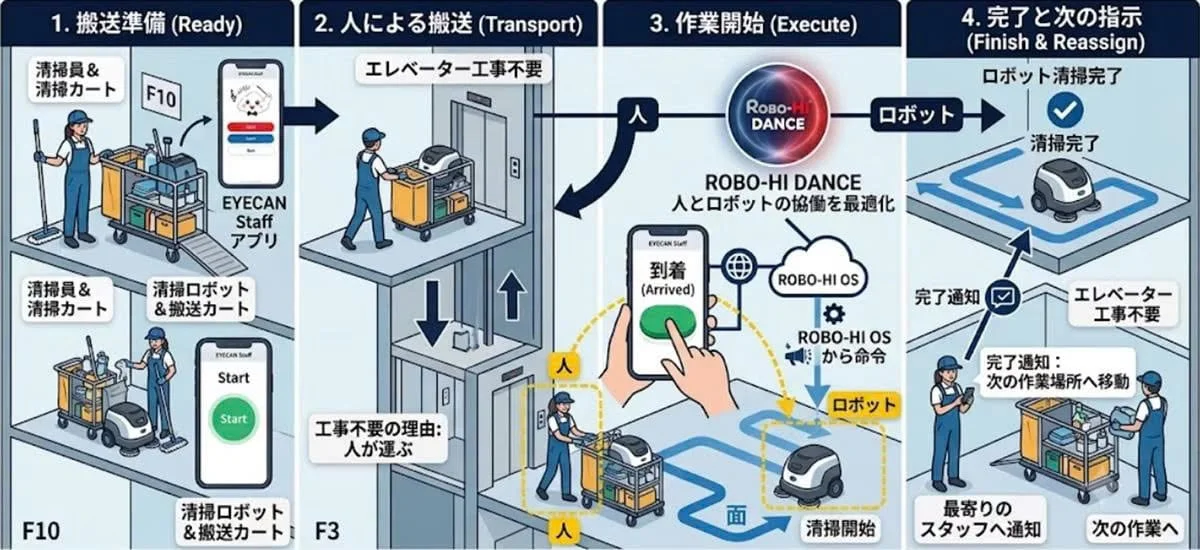
3. Centralized management with "ROBO-HI® AOS"
By connecting to the operation management OS, multiple AGVs can be controlled synchronously and monitored remotely on the same system. This solution supports the building of safe and unmanned smart factories.
Guidance on heavy load transport optimization and deployment feasibility diagnostics
ROBO-HI regularly conducts on-site surveys and diagnostics to assess suitability by studying the current transport routes, cargo shapes, and factory environments at customers' plants/business facilities.
ROBO-HI will evaluate "whether it can be replaced by AGVs" and "what safety and productivity improvement effects can be expected".